
On October 20, 1967, along Bluff Creek in Northern California, Roger Patterson and Bob Gimlin pointed a rented camera at a large dark figure walking across a gravel bar. It covered fifty-nine and a half seconds of film, turned its head to look back at them around frame 352, and stepped into the trees. People have been arguing about those fifty-nine seconds for almost sixty years. Nobody has proven it real. Nobody has fully killed it either. That's the cryptid deal in a single reel.
Cryptids are the folklore we never quite let go of. Some come with decades of blurry photographs, some come with one shaky story and a cousin who swears, and a couple of them quietly graduated to real biology while we weren't looking. Here's the full roster, scored on three things at once: how plausible the creature is, how good the story is, and how it holds up as something you'd wear. Number one wins all three.
1. Bigfoot
The franchise player, and it isn't close. Bigfoot has the Patterson-Gimlin film, thousands of reports fanning out across the Pacific Northwest, an entire hobby-science (cryptozoology) that practically organized itself around him, and a habitat so vast and thickly forested that the "we'd have found him by now" argument can be explained away. He's plausible enough to keep a straight face about and famous enough to headline the whole genre. If the others are the supporting cast, Bigfoot is the reason there's a cast at all.
2. The Loch Ness Monster
Nessie went supernova in 1933, right after a new road opened along the loch and gave motorists a clear view of the water. The image that locked her into the culture was the 1934 "Surgeon's Photograph," that graceful little neck rising from the surface. It held up for sixty years, until a 1994 confession revealed the whole thing was a toy submarine with a sculpted head. Didn't matter. Nessie had already built a Scottish tourism economy and a permanent lease on the world's imagination. Debunked yet undefeated.
3. Chupacabra
The new kid, and the only one on this list younger than half of our customers. First reports came out of Puerto Rico in 1995, livestock drained of blood, the name literally meaning "goat-sucker." It spread fast through Latin America and up into Texas. Nearly every captured chupacabra turns out to be a coyote with a bad case of mange. Believers will tell you that's what a chupacabra wants you to think.
4. The Kraken
The one that got promoted. For centuries the Kraken was a monster of the North Atlantic, a beast big enough to pull ships under, filed firmly under sailor's nonsense. Then biology caught up. The giant squid is real, can reach forty feet or more, was first photographed alive in 2004, and was finally filmed in the deep in 2012. The Kraken didn't get debunked. It got a diploma. Every other cryptid on this list is chasing what it already has.

5. The Yeti
Bigfoot's high-altitude cousin, stationed in the Himalayas, announced mostly by outsized footprints in fresh snow. Everest expeditions have chased him, monasteries have claimed relics, and a Rankin/Bass Christmas special gave his snowy cousin a dentistry subplot, which is not nothing. He loses points only because the terrain is so extreme that "we can't find him" is a weaker alibi up there than it is in a Washington rainforest.
6. Mothman
Point Pleasant, West Virginia, late 1966. Witnesses describe a winged figure, seven feet tall, with red eyes that reflected the headlights. For thirteen months the sightings pile up, and then, in December 1967, the Silver Bridge collapses into the Ohio River and kills forty-six people, and the whole legend curdles into something darker. Mothman stopped being a monster story and became an omen. He now has a museum, an annual festival, and a gleaming chrome statue, which is more civic infrastructure than most real animals get.
7. The Jersey Devil
The oldest story here, and one of the best. Since 1735, the Pine Barrens of New Jersey have belonged to the cursed thirteenth child of Mother Leeds, born with hooves, wings, and a horse's head. Terrific origin, creepy home turf, and enough staying power that an NHL team took the name. Physical evidence is thin to nonexistent, but the legend has outlived nearly three centuries of skeptics.
8. The Jackalope
Zero plausibility, maximum charm. The jackalope, a jackrabbit crowned with antelope horns, was invented in Douglas, Wyoming, in the 1930s by a pair of taxidermist brothers with a spare set of horns and a sense of humor. It fooled nobody and delighted everybody, and it's been the patron saint of the roadside gift shop ever since. Dead last on evidence, comfortably first in our heart.
Bonus Round
The bench runs deep, and any of these could carry their own list on a slow news week.
The Flatwoods Monster is West Virginia's second entry, after Mothman, a ten-foot visitor with a glowing face who dropped into a Braxton County farm field in 1952. West Virginia is clearly a state with some monster range.
Round out the bench with the Thunderbird of Native American legend and grainy Old West photos; Ogopogo and Champ, the lake monsters who never got Nessie's PR budget; and the Beast of Bray Road, Wisconsin's contribution to the werewolf-adjacent economy.
And then there are the visitors from upstairs, who don't technically count, since they're ufology's problem, not ours. The Navy has footage of their rides. Nobody has a clean shot of the drivers.
Deal Them In
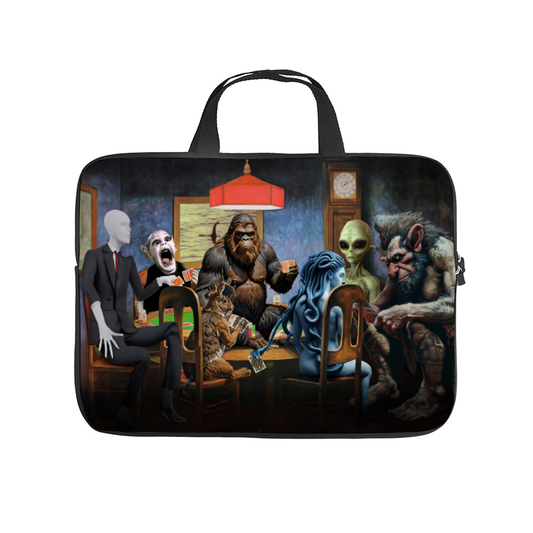
Famous as they are, the cryptids almost never get a group portrait. Every one of them works alone, in the dark, at a safe distance from the camera. So we sat some down at the same table for a friendly game of poker.