
If you've spent any time in the weirder corners of the internet and encountered references to a secret organization that contains reality-breaking anomalies, classified documents written in bone-dry bureaucratic language, and creatures you can only describe by what they are not, you've already grazed the outer edge of the SCP Foundation. This is your full briefing.
It Started With a Statue That Kills You If You Look Away
On June 22, 2007, at 1:40 in the morning, a user going by the name Moto42 posted something unusual to 4chan's /x/ board, the corner of that site dedicated to paranormal stories and creepypasta. It was a short document written in the style of a classified scientific report, describing a concrete statue that could not move while being directly observed, but moved with lethal speed the moment you looked away.
The object was designated SCP-173. The document described its containment procedures in the same flat, procedural tone you'd expect from a government manual about handling biohazardous waste. No dramatic narration. No jump scares. Just: here is what it does, here is how you contain it, here is what happens when you don't.
The /x/ community noticed immediately that something different was happening. Other creepypastas were trying to scare you. This one was trying to make you believe in an institution. Within days, other users were posting their own reports in the same format, adding new anomalies to what was becoming a shared fictional universe. By January 2008, a dedicated wiki had been established to organize the growing collection. By July of that year it had moved to Wikidot, where it lives today.
As of 2026, the SCP Wiki contains nearly 9,000 entries, 15 official language branches, and is considered by some researchers to be the largest collaborative writing project in history.

What Does SCP Actually Stand For?
Two things, depending on whether you're asking in-universe or out.
Out of universe, SCP is just the designation system the writing community adopted: each anomalous object gets a number and a file. The letters were retrofitted with meaning after the fact.
In-universe, SCP stands for Secure, Contain, Protect, which is both the name of the organization and its three-word mission statement. The Foundation is a massive, fictional, entirely secret global bureaucracy whose job is to find anomalies, things that break the rules of reality, and keep them away from the general public. Not to study them for humanity's benefit. Not to weaponize them. Just to contain them and keep the world from knowing they exist.
The Foundation operates under a classification system most SCP readers learn early. Safe designates anomalies that are well understood and easily contained. Euclid covers anomalies whose behavior is unpredictable or insufficiently understood. Keter is reserved for anomalies that are actively dangerous and extremely difficult to contain. There are additional classifications, but those three are the backbone.
Why Does It Work So Well?
The format is the trick. By writing horror as bureaucracy, the SCP community stumbled onto something genuinely strange: clinical language applied to impossible things creates a specific kind of dread that straight-up scary prose can't touch.

Reading an SCP entry feels like finding a document you weren't supposed to find. The detachment is unsettling precisely because it implies the organization has seen enough of this that it no longer warrants dramatic language. SCP-682 is a nearly indestructible reptilian creature that hates all life and has survived every termination attempt the Foundation has tried. Its file reads like a maintenance log.
The wiki's community maintains this tone with remarkable discipline across thousands of contributors. There are style guides. There are rating systems. Submissions that don't clear a quality threshold get pulled. The result is a vast fictional world with genuine internal consistency and a house voice that is immediately recognizable.
The Antimemetics Division: The Most Mind-Bending Corner of the SCP Universe
Here is where it gets philosophically interesting.
A meme, in the original sense coined by biologist Richard Dawkins, is a unit of cultural information that spreads from mind to mind. An idea that replicates. An antimeme is the inverse: an idea with self-censoring properties, a concept that, by its intrinsic nature, resists being remembered, shared, or known.
Antimemes are technically real, in a mundane sense. Passwords are antimemetic by design. So are taboos. So is genuinely boring information. Your brain filters out things that don't seem worth retaining. That's normal cognition. But the SCP universe asks: what if that filtering wasn't just a cognitive quirk, but a property of the information itself? What if some things don't want to be known?
The Antimemetics Division is a department within the Foundation dedicated entirely to containing anomalies that erase themselves from memory and perception. Staff members rely on drugs called mnestics to maintain awareness of things their minds would otherwise refuse to register. The problem with fighting antimemetic entities is that you can't take notes, because the notes become unreadable. You can't remember your training, because the training refers to things you can't remember. You wake up on what you think is your first day on the job. It is not your first day.
The entire concept was developed by British writer Sam Hughes, writing under the pen name qntm, beginning with SCP-055, a non-spherical object that cannot be remembered. The entry doesn't describe what the object looks like or does. It can only describe what the object is not: not spherical, not without mass, not dangerous in a conventional sense. Every positive attribute slides off the mind like water off glass.
Hughes later expanded this idea into a full serialized novel called "There Is No Antimemetics Division," published chapter by chapter on the SCP Wiki between 2015 and 2020. It was released as a self-published book in 2021 and then picked up by Penguin Random House's Del Rey Books imprint for a revised mainstream publication in November 2025, which is notable for a work of collaborative internet fiction. It received serious critical attention, with the Washington Post comparing its ambition to Lovecraft.

The novel follows Marion Wheeler, director of the Antimemetics Division, as she and her team fight an escalating war against an apex antimemetic entity called SCP-3125, a conceptual hazard so dangerous that simply understanding it sets off a lethal chain reaction. The challenge of the story is structural: how do you write a narrative about characters who keep forgetting what they're doing? Hughes solves it in ways that are genuinely clever, including strategically redacted passages that make the reader experience the same informational gaps the characters do.
If you want a place to start with SCP before diving into the full wiki, the Antimemetics Division is one of the most coherent and rewarding entry points. It has a beginning, a middle, and an end, which not all SCP content does.
The Scope of What's on the Wiki
The wiki's range is genuinely staggering. There are heartbreaking entries. There are funny ones. There are entries that are literary experiments as much as horror fiction. SCP-999, a cheerful orange slime creature whose touch induces joy, exists in the same universe as SCP-682, the unkillable reptile that despises all living things. SCP-294 is a vending machine that can dispense anything that can exist in liquid form, including certain abstract concepts. SCP-426 is a toaster that can only be referred to in the first person.
The wiki also spawned a significant gaming ecosystem. SCP: Containment Breach, a free indie horror game released in 2012, introduced the Foundation to an enormous new audience and remains one of the most influential pieces of fan-created content in the community's history. The video game Control, released by Remedy Entertainment in 2019, was heavily influenced by SCP aesthetics, centering on a government bureau that collects mundane objects with paranormal properties.

Who Actually Writes This Stuff?
Anyone. That's the point. The SCP Wiki is a community project under a Creative Commons license, meaning anyone can submit entries, tales, or supplementary material. Submissions go through a rating process and can be removed if they don't meet the community's standards. The most celebrated entries are written with craft and care. Some of the best ones read like genuine short fiction by writers who understand pacing, dread, and the specific power of leaving things unexplained.
This is also why the universe has no single canon. Different entries can contradict each other. Different authors have different ideas about what the Foundation is, what its ethics are, and what its ultimate purpose might be. That looseness is a feature. It keeps the world from calcifying into something a single author controls.
One Last Thing
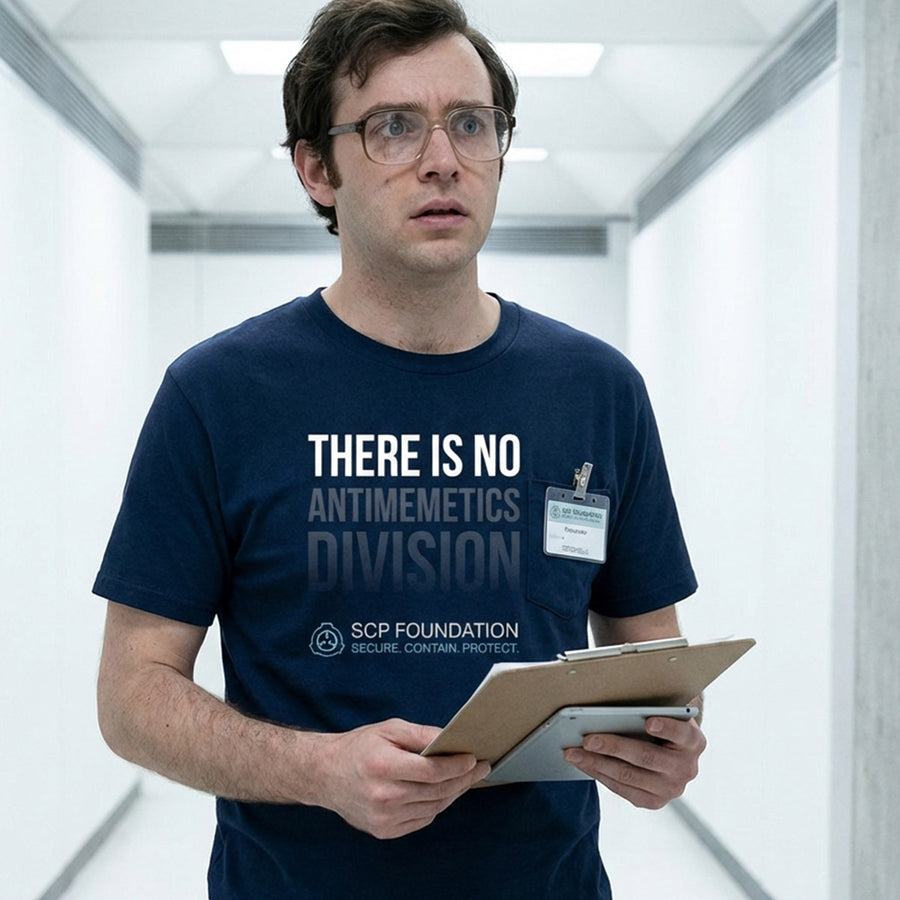
The Antimemetics Division shirt in our catalog exists because the concept felt like it belonged on a shirt. The idea that some things survive by not being noticed. That the most dangerous entities might be the ones you've already forgotten. That there's an entire division dedicated to fighting a war nobody remembers they're in.
The shirt is either the nerdiest thing we make or the most profound. Possibly both.
You may or may not remember reading this.