
Somewhere in a storage unit right now, there is a box of newsletters. Nobody knows whose newsletters. Nobody wants to know. They were produced sometime in the early 1990s on a Macintosh running PageMaker, and they feature no fewer than seven typefaces, a clip art border of small running dogs, and a headline in 48-point Papyrus announcing a rummage sale that happened thirty years ago. They are the pure product of a tool meeting a person with nothing to say and every possible way to say it.
We have been here before. Many times. The conversation we are currently having about AI-generated content, the one where everyone is very concerned about the flood of cheap, soulless, algorithmically-averaged product washing over culture, is an old conversation wearing a new hat.
Every time a new technology has lowered the barrier to making something, the first thing that happens is a flood of mediocre product made by people who now can but probably shouldn't. The second thing that happens, is that someone figures out what the tool actually makes possible, and makes something that could not have existed any other way.

The printing press showed up in the 1440s and immediately there were pamphlets. Apocalyptic pamphlets, political pamphlets, pamphlets about the correct interpretation of scripture written by people who had very strong feelings and access to movable type. The 16th century information environment was, by serious historical accounts, a carnival of misinformation, propaganda, and theological screaming. Martin Luther understood that the press was a weapon before almost anyone else did, and he used it like one.
And yet. The same press that produced the pamphlets produced the novel. Which was itself considered low and dangerous and somewhat embarrassing, particularly for women who read them and might get ideas. Authors like Daniel Defoe (Robinson Crusoe) and Samuel Richardson (Tom Jones), working in a form that the educated class viewed the way we now view content farms, accidentally built the dominant art form of the next three centuries. The flood of cheap print and the birth of literary fiction were not separate events. They were the same event.
This pattern has a habit of repeating.

When MIDI arrived in 1983, it handed musicians access to instruments they could not afford and could not play. Hotel lobbies acquired soundtracks. Corporate presentations acquired underscore. The General MIDI preset library, with its heroic attempts to simulate a trumpet and its failure to simulate anything resembling a living trumpet player, became ambient wallpaper for a decade of waiting rooms. Meanwhile, a bass synthesizer called the Roland TB-303 was such a spectacular commercial failure that Roland discontinued it. Musicians bought them out of pawn shops for fifty dollars because fifty dollars was what they cost. DJ Pierre and Phuture in Chicago started doing things to the 303 that Roland had specifically not intended, cranking the resonance into ranges that sounded broken, and invented acid house. Detroit producers using the same cheap, democratized gear built techno. The instruments' failure modes became the genre. This is not a minor footnote. This is the origin story of entire global musical cultures.
Desktop publishing gave everyone a printing press and most of them used it to make the newsletters in the storage unit. It also gave Rudy VanderLans and Zuzana Licko a reason to start Emigre magazine, which looked like nothing that had existed before because it was built from low-resolution bitmap fonts that the Mac produced and that traditional typography could not replicate. They did not fight the tool's limitations. They made the limitations the point.
Photoshop arrived and immediately produced glows, the lens flare, the beveled chrome text, the inexplicable swoosh. Mid-nineties movie posters that looked like a glowing fever dream.

It also gave Andreas Gursky the ability to make photographs of things that did not exist. His Rhein II, a stretch of river with everything removed that made it look like an actual riverbank, flattened to pure horizontal color, is simultaneously a photograph and not one.

Then there is VHS.
The video store back wall was a monument to the economics of democratized distribution. Thousands of shot-on-video productions, direct-to-video sequels to films that barely existed in the first place, the entire infrastructure of cinematic mediocrity made commercially viable by cheap tape and low barriers to shelf space. But the same back wall, in a store in Manhattan Beach called Video Archives, was a graduate school for a guy named Quentin Tarantino who was watching everything, including all of it, including the Italian giallo and the Hong Kong action films and the B-movies that had nowhere else to live. His entire aesthetic is a video store built into a human brain. Pulp Fiction, which is partly about pulp, required the pulp to exist. It required someone to take the flood seriously enough to swim in it.

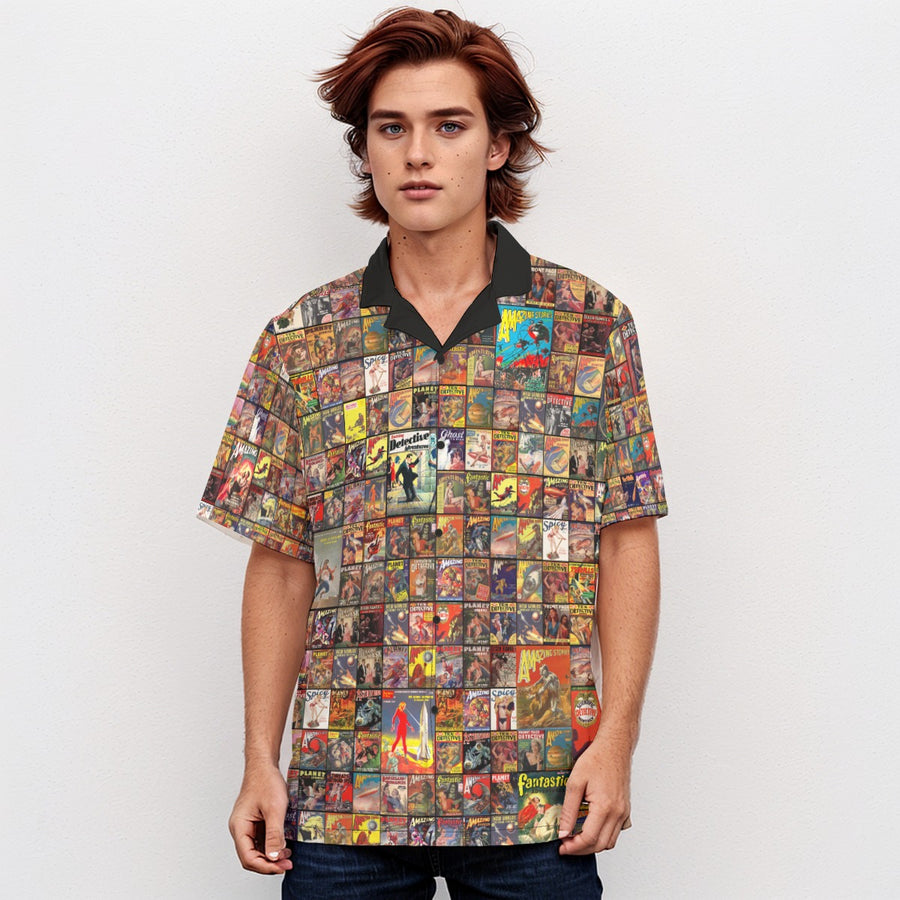
And the pulp was always worth swimming in. Before VHS there were the pulp magazines themselves, the original sin of democratized media: wood pulp paper, cheap ink, disposable fiction bought by the word from writers who needed the money and editors who needed the pages filled. Weird Tales, Black Mask, Amazing Stories, spinning racks of ten-cent entertainment that the literary establishment regarded the way fine dining regards a gas station hot dog. Raymond Chandler developed one of the most imitated prose styles in American literary history inside those pages. Dashiell Hammett essentially invented the hard-boiled detective novel as a pulp serial. Philip K. Dick published nearly everything that would later make him a philosophical touchstone in magazines that cost a dime and were read on the bus. H.P. Lovecraft built an entire mythology, one that is still generating derivative works eighty years later, in a market that paid him almost nothing and folded before he died. The economic model that produced mountains of forgettable genre fiction was not separate from the model that produced the work. They were the same model. The flood and the art shared the same water.
None of this is a guarantee about AI. The printing press also produced a lot of pamphlets that stayed pamphlets. Those Roland 303s sat in pawn shops for years before Chicago found 'em. Chandler wrote his first pulp story at forty-four, after losing his job in the oil business, because he needed the money and the pulps were buying. The art rarely announces itself as art when it arrives.
The question that history keeps asking, and that artists keep answering in ways nobody predicted, is NOT whether the tool will be used badly. It will. It already is. The question is what it makes possible that was impossible before, and who is in the pawn shop right now looking at the broken thing and hearing something the rest of us haven't heard yet.